Wanlin Group · AndroidSBC · Information Publishing Screen Android Motherboard for Rotterdam, Netherlands | Wanlin
Information Publishing Screen Android Motherboard for Rotterdam, Netherlands | Wanlin
Wanlin Information Publishing Screen Android Motherboard project planning for warehouse dispatch information screens in Rotterdam, Netherlands, with custom development, sample evaluation and export cooperation.
Configuration and document request
Content updated:
Use the exact configuration and controlled documents for a product decision.
Availability: Request confirmation for the selected configuration.
Details
Project overview: Information Publishing Screen Android Motherboard for warehouse dispatch information screens
Suggested evaluation configuration for the Information Publishing Screen Android Motherboard: RK3568; 4 GB RAM; 32 GB eMMC; one 1920 x 1080 landscape display.
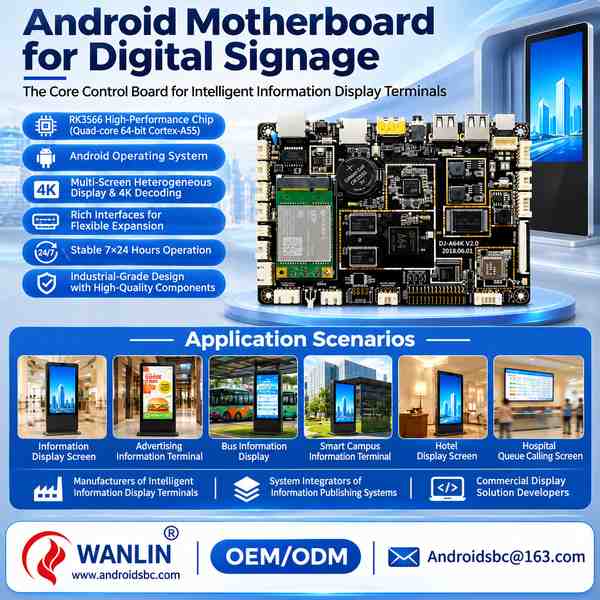
A Information Publishing Screen Android Motherboard displays dispatch data and operational notices. For Rotterdam, Netherlands, this project brief focuses on warehouse dispatch information screens, including dispatch feed, shift notices and loading-bay status.
Wanlin Group / AndroidSBC welcomes warehouse integrators and industrial display distributors seeking a China manufacturing partner for board supply and custom development. The configuration above is a proposed engineering target, not a released model specification or a statement of stock availability. Engineering review determines the supported memory, interfaces, firmware and mechanical implementation.
The dedicated topic domain for this article is www.androidsbc.com. Use that domain for this product topic; send commercial and development enquiries through the AndroidSBC main website listed below.
What should buyers specify before requesting this motherboard?
For the Information Publishing Screen Android Motherboard, the decisive requirement is feed timestamp and maximum acceptable data age. Define that requirement alongside the application dispatch feed, shift notices and loading-bay status so the development proposal describes the equipment behavior the buyer actually needs.
Wanlin supports board selection and custom development from Shenzhen. A practical enquiry includes the proposed RK3568; 4 GB RAM; 32 GB eMMC; one 1920 x 1080 landscape display, the enclosure drawing, actual peripheral part numbers and the application package. These proposed parameters require confirmation against a released configuration.
For warehouse dispatch information screens in Rotterdam, Netherlands, the local partner should prepare Dutch and English operator notices, site time zone and loading-bay terminology. These are project requirements to discuss, not assertions that a local installation or service office already exists.
The approval package should contain feed schema, refresh rules and timestamped recovery log. This is what makes the proposal reviewable and repeatable for purchasing and service teams.
Use samples to establish compatibility before negotiating production release. Agree development charges, ownership, licensing, warranty, delivery responsibilities and change notifications in the quotation.
Product overview: How the board fits the equipment
In warehouse dispatch information screens, the motherboard provides the embedded computing and interface layer. The complete equipment also includes the enclosure, power supply, application and peripherals. The project needs a controlled definition of how these parts interact.
- Primary workflow: dispatch feed, shift notices and loading-bay status.
- Development priorities: timestamp display, cached notices and controlled content refresh.
- Reference configuration: RK3568; 4 GB RAM; 32 GB eMMC; one 1920 x 1080 landscape display.
- Buyer profile: warehouse integrators and industrial display distributors.
- Destination planning: Rotterdam, Netherlands.
- Supply origin: Shenzhen, China.
- Release basis: an approved hardware and software configuration.
The dedicated domain preserves the product identity from discovery through enquiry. It does not replace a dated datasheet or a quotation identifying the actual board revision.
Application scenario: A practical integration review
Consider a proposed warehouse dispatch information screens installation in Rotterdam, Netherlands. This is an engineering scenario, not a claim about an existing customer deployment. A dispatch feed can become stale while the screen still looks operational. Show the last successful refresh and a clear stale-data state rather than leaving an old loading instruction visible.
At the pilot stage, disconnect the dispatch feed, change the shift schedule and restore the network. Record what the operator sees, what data is retained and whether a technician must visit the site. The acceptance decision should follow those observations, not the successful playback of a demonstration image.
What causes integration failures in this application?
For warehouse dispatch information screens, a critical integration risk is loss of clarity about feed timestamp and maximum acceptable data age. A dispatch feed can become stale while the screen still looks operational. Show the last successful refresh and a clear stale-data state rather than leaving an old loading instruction visible.
Separate the application state from peripheral connection status and operating-system recovery. The test must identify which component detects the fault, which state is retained and which operator action is allowed. A restart alone is not evidence of a complete recovery.
- Identify the exact hardware and software used in the failure.
- Record the triggering action: Stop the feed while leaving the network connected.
- Compare observed behavior with this criterion: The display must identify stale information according to the agreed policy.
- Attach feed schema, refresh rules and timestamped recovery log.
- Repeat the original workflow after the correction.
Custom development: Define work and deliverables
Wanlin can review timestamp display, cached notices and controlled content refresh as part of a custom development enquiry. The scope is established from the equipment brief and the supported platform, with hardware changes separated from software configuration.
| Requirement | Development scope | Acceptance deliverable |
|---|---|---|
| dispatch feed, shift notices and loading-bay status | Application and peripheral integration | Demonstrate the complete operator workflow |
| timestamp display, cached notices and controlled content refresh | Agreed hardware and BSP changes | Versioned configuration and interface definitions |
| Production repeatability | Provisioning and release controls | Approved build identifier and pilot record |
| Local servicing | Recovery and escalation procedure | Repeat the documented recovery test |
Agree drawings, firmware deliverables, licensing, source access where required and maintenance responsibilities before development begins. A service described in an enquiry is not automatically included in the board unit price.
How should the pilot demonstrate that the equipment is ready?
The Information Publishing Screen Android Motherboard pilot should verify feed timestamp and maximum acceptable data age under the intended workload. The sequence below is a proposed acceptance method, not a report of measured performance. The buyer and developer must agree duration, repetitions and thresholds before execution.
| Dimension | Baseline to record | Proposed acceptance method |
|---|---|---|
| Normal operation | dispatch feed, shift notices and loading-bay status | Complete the workflow using production software and peripherals |
| Fault injection | Stop the feed while leaving the network connected | The display must identify stale information according to the agreed policy |
| Configuration | Board revision, software and peripheral identifiers | Record the version of every component affecting the result |
| Evidence | feed schema, refresh rules and timestamped recovery log | Attach dated observations and unresolved limitations |
| Repeatability | Approved test sequence | Repeat under the same recorded conditions |
Record the starting state, action, expected state, observed state and recovery action for each test. A failed test remains visible in the report until closed or accepted with a documented limitation. Do not publish throughput, uptime or cost savings derived from this worksheet until actual results support them.
Specifications: Proposed configuration for quotation
The following specification is an RFQ starting point. It must be checked against a supported board and current controlled documents.
| Block | Requirement |
|---|---|
| Evaluation configuration | RK3568; 4 GB RAM; 32 GB eMMC; one 1920 x 1080 landscape display |
| Application | warehouse dispatch information screens |
| Workflow | dispatch feed, shift notices and loading-bay status |
| Development priorities | timestamp display, cached notices and controlled content refresh |
| Operating system | Android build and application dependencies to be agreed |
| Electrical design | Input range, interface levels and peripheral load to be documented |
| Mechanical design | Board dimensions, fixing points and connector clearance to be approved |
| Destination | Rotterdam, Netherlands |
| Commercial scope | Samples, development charges, price, MOQ and delivery by written quotation |
What operating evidence should the supplier and buyer retain?
For Information Publishing Screen Android Motherboard projects, useful operating evidence connects feed timestamp and maximum acceptable data age to a reproducible test. A hardware checklist cannot replace an application-level acceptance record.
| Evidence item | What to record | Why it matters |
|---|---|---|
| Configuration | Processor selection, PCB revision and Android build | Keeps repeat tests on the same release |
| Workflow | dispatch feed, shift notices and loading-bay status | Defines the work being evaluated |
| Fault sequence | Stop the feed while leaving the network connected | Makes recovery behavior reproducible |
| Pass condition | The display must identify stale information according to the agreed policy | Distinguishes an observation from acceptance |
| Supporting files | feed schema, refresh rules and timestamped recovery log | Supports engineering review and later servicing |
Interface layout: Interface positions to review before enclosure release
- Main display connection and timing.
- Touch or operator-input connection.
- Application-specific peripherals for dispatch feed, shift notices and loading-bay status.
- Ethernet or approved wireless link.
- Power input and peripheral power distribution.
- Audio, camera or instrument path where required.
- Service access and recovery controls.
- Mounting points, antenna clearance and cable strain relief.
Do not assume every connector can operate simultaneously. Request a resource map and note any shared pins or mutually exclusive modes. Where isolation is required, specify it at system level and verify the proposed implementation.
Power and thermal design: Qualify the assembled equipment
For warehouse dispatch information screens, test the proposed RK3568 platform inside the intended enclosure. Use the selected power supply and connected peripherals rather than testing an unloaded board on an open bench.
The installer in Rotterdam, Netherlands should record actual site conditions, ventilation, cable routes and service access. Region alone does not establish temperature, humidity or power quality. Measure startup, sustained workload and fault recovery against the approved electrical and thermal limits.
Assembly and integration: Seven release checks
- Match board and peripheral revisions.
- Verify supply polarity and electrical limits.
- Confirm cable orientation and connector retention.
- Use approved mounting and ESD procedures.
- Install the identified software build.
- Run the application-specific test: disconnect the dispatch feed, change the shift schedule and restore the network.
- Record serial numbers, inspection results and packing configuration.
Application matrix: Extend the project without losing configuration control
| Deployment | Integration risk | Development response |
|---|---|---|
| warehouse dispatch information screens | A dispatch feed can become stale while the screen still looks operational. Show the last successful refresh and a clear stale-data state rather than leaving an old loading instruction visible. | timestamp display, cached notices and controlled content refresh |
| Pilot installation in Rotterdam, Netherlands | Site requirements differ from the bench | Record actual network, power and operator behavior |
| Repeat-order equipment | A substituted peripheral changes behavior | Approve substitutions against the original test |
| Distributor service unit | Recovery instructions are incomplete | Provide the agreed recovery image and procedure |
For local relevance, prepare operator language, site access, installation instructions and spare-unit responsibilities with the regional partner. A translated menu or a location name alone does not establish a locally supported product.
Development and export workflow: Eight steps to release
- Submit the product brief and target country.
- Review RK3568; 4 GB RAM; 32 GB eMMC; one 1920 x 1080 landscape display.
- Approve timestamp display, cached notices and controlled content refresh.
- Agree charges, deliverables and acceptance conditions.
- Evaluate samples with the actual peripherals.
- Pilot the equipment in the intended workflow.
- Close issues and freeze hardware and software revisions.
- Release production with inspection and shipment records.
For an export quotation, provide quantities, schedule, destination, shipping responsibilities and document requirements. Compare hardware, development, testing, freight, import charges and local integration on the same basis. No universal price, delivery time or MOQ is claimed.
Manufacturing and partner cooperation: Assign responsibility
| Responsibility | Factory scope to agree | Regional partner contribution |
|---|---|---|
| Engineering | timestamp display, cached notices and controlled content refresh | Supply site and peripheral requirements |
| Validation | Samples and agreed technical records | Evaluate dispatch feed, shift notices and loading-bay status |
| Export | Packing and shipment documentation | Confirm importer and destination delivery |
| Support | Technical escalation and warranty scope | Installation and local service access |
Wanlin welcomes export trading companies as well as equipment manufacturers. A useful cooperation enquiry describes the channel, first project, forecast volume and service capability. Exclusivity and long-term supply commitments require separate written terms.
What customer evidence would make this application claim credible?
A credible reference for warehouse dispatch information screens identifies the installed configuration, the operator workflow and the service period. No verified deployment outcome or customer endorsement is supplied with this article; the application scenario is an engineering example.
For this product, request feed schema, refresh rules and timestamped recovery log. Permissioned customer feedback should explain whether the display must identify stale information according to the agreed policy, under the customer's recorded conditions. A quotation from an unnamed buyer is not a substitute for those records.
For Rotterdam, Netherlands, verify Dutch and English operator notices, site time zone and loading-bay terminology with the actual installer. Publish customer names, results and photographs only with permission and supporting records.
Frequently asked questions
What does a Information Publishing Screen Android Motherboard do?
A Information Publishing Screen Android Motherboard displays dispatch data and operational notices. In warehouse dispatch information screens, its role is to support dispatch feed, shift notices and loading-bay status.
Which parameters should I use for the first enquiry?
Use this evaluation target: RK3568; 4 GB RAM; 32 GB eMMC; one 1920 x 1080 landscape display. It is an RFQ proposal; the actual order must identify a supported model and revision.
What development work matters for this application?
Prioritize timestamp display, cached notices and controlled content refresh. The review should define hardware changes, software work and the acceptance evidence separately.
How should recovery be tested?
Stop the feed while leaving the network connected. The display must identify stale information according to the agreed policy. Record conditions and actual results rather than assuming the proposal has already passed.
What documents should accompany sample approval?
Request feed schema, refresh rules and timestamped recovery log, together with the approved board revision and software build.
What should the regional partner prepare?
For Rotterdam, Netherlands, discuss Dutch and English operator notices, site time zone and loading-bay terminology. Confirm site-specific needs with the end customer.
How do the topic domain and company website relate?
This article maps Information Publishing Screen Android Motherboard to www.androidsbc.com. AndroidSBC corporate enquiries use https://www.androidsbc.com. The domain name does not determine processor architecture; the quoted specification does.
How can an importer request cooperation?
Send the application, destination, forecast quantities and development requirements to Androidsbc@163.com or +8613261677119. Agree manufacturing, shipment and local service responsibilities in writing.
Next step: Request a development and export proposal
For warehouse integrators and industrial display distributors working on warehouse dispatch information screens in Rotterdam, Netherlands, the next step is a defined sample and development proposal. Identify dispatch feed, shift notices and loading-bay status and the acceptance sequence before committing to production.
Ask Wanlin to review timestamp display, cached notices and controlled content refresh against the proposed configuration. A clear scope connects the product requirement to deliverables, pilot evidence and repeat-order supply.
Published by Wanlin Group / AndroidSBC. Published on November 4, 2026. Topic domain: www.androidsbc.com.
Company address: Wanlin Group, Building B, Building 1, Beisida Medical Device Building, 28 Nantong Avenue, Baolong Community, Baolong Sub-district, Longgang District, Shenzhen, Guangdong, China
Email: Androidsbc@163.com | Export Hotline: +8613261677119 | Website: https://www.androidsbc.com
Source and evidence boundary: the dedicated domain identifies the product topic; the technical values in this article are proposed RFQ requirements, not independently tested product claims. Current availability, controlled specifications and commercial terms require supplier confirmation.
Engineering references: Wanlin Android BSP requirements and release controls; Wanlin development and manufacturing process. These sources support the engineering process; they do not verify the proposed parameters or application results in this article.
Product: Information Publishing Screen Android Motherboard
Topic domain: www.androidsbc.com
Application: warehouse dispatch information screens
Region: Rotterdam, Netherlands
Evaluation target: RK3568; 4 GB RAM; 32 GB eMMC; one 1920 x 1080 landscape display
Email: Androidsbc@163.com | Export Hotline: +8613261677119 | Website: https://www.androidsbc.com
Evidence and publishing boundary
Published by Wanlin Group under the AndroidSBC identity. Confirm capabilities for the exact model, PCB revision and software build using controlled documents and agreed tests. Editorial maintenance is not an engineering certification.
Document status · Editorial policy · Request project evidence
Prev:RK3566 Dual-Screen Payment Terminal Board
Next:no more
