Wanlin Group · AndroidSBC · RK3568 smart payment terminal embedded board Industrial
RK3568 smart payment terminal embedded board Industrial
Review RK3568 smart payment terminal embedded board Industrial requirements, interfaces, software and acceptance scope. Confirm the exact model configuration against current controlled project documents.
Configuration and document request
Content updated:
Use the exact configuration and controlled documents for a product decision.
Availability: Request confirmation for the selected configuration.
Details
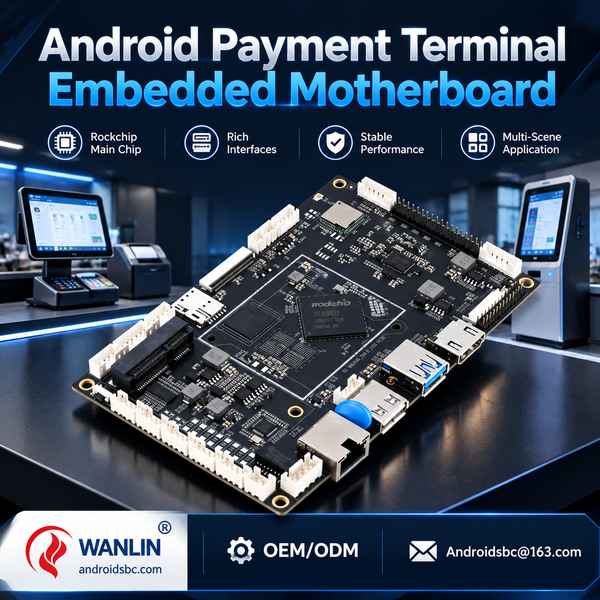
Core parameters: Rockchip RK3568 quad-core SoC, 4x Cortex-A55 with an integrated NPU. CPU 4x ARM Cortex-A55 up to 2.0GHz, 64-bit architecture. GPU ARM Mali-G52 2EE GPU, OpenGL ES 3.2 / Vulkan 1.1. Render and security path Mali-G52 2EE render path with the on-chip NPU handling QR decode assist, face detection and product recognition for AI cashier and smart scale projects. Video decode Hardware decode up to 4K@60fps across H.265, VP9 and H.264, with 1080P@60fps encode for audit capture. Camera input MIPI CSI camera input for face payment cameras, 2D barcode imagers and document capture. Memory and storage 8GB LPDDR4X + 16GB eMMC. Operating system Android 14.0 with OTA upgrade, per-unit provisioning and a locked launcher. Display and touch 10.1-inch 1280x800 LVDS panel with capacitive multi-touch and a secondary HDMI customer display. Audio and signalling Speaker, microphone and headphone jack for attended counter intercom headsets. Interfaces and I/O 2x display channels (LVDS or eDP main with MIPI DSI or HDMI secondary), 1x MIPI CSI camera, 4x USB Host with 1x USB OTG, 2x RS232 with TTL UART option, 1x thermal printer head and cutter control, 1x scan engine UART, GPIO, I2C, SPI, PWM and ADC expansion. Networking 4G LTE with dual-band WiFi, Bluetooth 5.2 and Ethernet on the carrier board. Power input 12 V DC input with an onboard buck stage, a separate supply path for the thermal printer head, RTC retention and scheduled power on/off for unattended duty. Duty profile Continuous unattended duty with hardware watchdog, RTC retention, scheduled power on/off and auto power on after a mains cut; a wide-temperature build is available for outdoor kiosks and cold rooms. PCB Smart payment terminal PCBA with onboard LPDDR and eMMC, dual display channels, camera input, printer and scan-engine headers, SIM and TF card slots, Ethernet and a USB service path. Certifications CE / FCC / RoHS / REACH with EMV, PCI and scheme-relevant documentation support. Wanlin's 2026 export roadmap for France also covers custom memory and storage combos, printer and scan engine interface selection, contactless antenna placement, custom peripheral drivers, private-label branding and per-destination certification documentation packages.
Global Desktop and Countertop Payment Terminal Boards Market Overview and 2026 Buyer Demand
Acquiring-side integrators are consolidating onto fewer board platforms because certification cost per device variant is the line item that kills small programmes. A single board that covers QR, contactless, EMV chip and magnetic stripe lets one certification budget serve four tender types, which is why dual-screen Android boards are displacing single-purpose payment boxes.
Regional compliance for France is anchored on CE under RED 2014/53/EU with ANFR radio filing and RoHS declarations. Cross-border buyers are advised to verify the certification scope, the contactless behaviour and the software build of every board before import, since some China-supplied boards ship without destination radio approval, without the payment documentation the acquirer asks for, or without the Android build the project actually needs, and any of those gaps can stall customs clearance or a scheme review.
Reference: Wanlin Group 2026 smart payment terminal export program documentation, Rockchip and Allwinner platform datasheets, field deployment records 2024-2026.
Desktop and Countertop Payment Terminal Boards Engineering Architecture and Hardware Platform
The smart payment terminal family is engineered on three pillars: (1) an Rockchip RK3568 quad-core SoC, 4x Cortex-A55 with an integrated NPU compute block with Mali-G52 2EE render path with the on-chip NPU handling QR decode assist, face detection and product recognition for AI cashier and smart scale projects; (2) a display and capture pipeline built around Hardware decode up to 4K@60fps across H.265, VP9 and H.264, with 1080P@60fps encode for audit capture; (3) a software layer pairing Android 14.0 with OTA upgrade, per-unit provisioning and a locked launcher with OTA tooling, device management and the Rockchip RK3568 Android BSP, AOSP build support, peripheral driver kit and the AndroidSBC SDK kit. This architecture delivers continuous counter and unattended duty at a cost point that undercuts cashier PCs while keeping the payment, print and scan response operators expect.
Three sub-modules define the engineering depth:
- Compute module - Rockchip RK3568 quad-core SoC, 4x Cortex-A55 with an integrated NPU. 4x ARM Cortex-A55 up to 2.0GHz, 64-bit architecture handles the tender flow, catalogue screens, signature capture and on-device vision work inside a fanless terminal shell.
- Display and capture module - 10.1-inch 1280x800 LVDS panel with capacitive multi-touch and a secondary HDMI customer display. MIPI CSI camera input for face payment cameras, 2D barcode imagers and document capture covers the camera input used for face payment, document capture and proof of purchase, so one device closes the transaction and records the evidence.
- Peripheral and management module - 2x display channels (LVDS or eDP main with MIPI DSI or HDMI secondary), 1x MIPI CSI camera, 4x USB Host with 1x USB OTG, 2x RS232 with TTL UART option, 1x thermal printer head and cutter control, 1x scan engine UART, GPIO, I2C, SPI, PWM and ADC expansion. Headless recovery is supported through the USB service path, and the toolchain covers Rockchip RK3568 Android BSP, AOSP build support, peripheral driver kit and the AndroidSBC SDK kit, OTA upgrade, boot animation customization, pre-installed app support and launcher customization for remote fleet management.
Mechanically the board is a Smart payment terminal PCBA with onboard LPDDR and eMMC, dual display channels, camera input, printer and scan-engine headers, SIM and TF card slots, Ethernet and a USB service path, which is why it drops into countertop shells, kiosk housings and wall-mounted enclosures without a tooling change.
Featured Model - RK3568-DT140 Industrial Technical Signature
The technical signature of RK3568-DT140 on this configuration is documented below. Every parameter is verified by our Shenzhen lab against the printer duty profile, the contactless read behaviour of the final enclosure and the electrical limits of IEC / UL 62368-1.
| Specification | Value |
|---|---|
| soc_platform | Rockchip RK3568 quad-core SoC, 4x Cortex-A55 with an integrated NPU |
| cpu_core | 4x ARM Cortex-A55 up to 2.0GHz, 64-bit architecture |
| gpu_3d | ARM Mali-G52 2EE GPU, OpenGL ES 3.2 / Vulkan 1.1 |
| render_security_path | Mali-G52 2EE render path with the on-chip NPU handling QR decode assist, face detection and product recognition for AI cashier and smart scale projects |
| video_decode | Hardware decode up to 4K@60fps across H.265, VP9 and H.264, with 1080P@60fps encode for audit capture |
| camera_input | MIPI CSI camera input for face payment cameras, 2D barcode imagers and document capture |
| memory_storage | 8GB LPDDR4X + 16GB eMMC |
| os_android | Android 14.0 with OTA upgrade, per-unit provisioning and a locked launcher |
| display_touch | 10.1-inch 1280x800 LVDS panel with capacitive multi-touch and a secondary HDMI customer display |
| audio_signalling | Speaker, microphone and headphone jack for attended counter intercom headsets |
| interfaces_io | 2x display channels (LVDS or eDP main with MIPI DSI or HDMI secondary), 1x MIPI CSI camera, 4x USB Host with 1x USB OTG, 2x RS232 with TTL UART option, 1x thermal printer head and cutter control, 1x scan engine UART, GPIO, I2C, SPI, PWM and ADC expansion |
| networking | 4G LTE with dual-band WiFi, Bluetooth 5.2 and Ethernet on the carrier board |
| power_input | 12 V DC input with an onboard buck stage, a separate supply path for the thermal printer head, RTC retention and scheduled power on/off for unattended duty |
| duty_profile | Continuous unattended duty with hardware watchdog, RTC retention, scheduled power on/off and auto power on after a mains cut; a wide-temperature build is available for outdoor kiosks and cold rooms |
| pcb_mechanics | Smart payment terminal PCBA with onboard LPDDR and eMMC, dual display channels, camera input, printer and scan-engine headers, SIM and TF card slots, Ethernet and a USB service path |
| use_case | countertop payment terminals that take QR, NFC contactless, EMV chip and magnetic stripe payments across a retail counter, driving a merchant screen and a customer screen at once and printing the receipt from the board |
Desktop and Countertop Payment Terminal Boards Application Scenarios across Deployment Sites
Deployment notes below come from live Desktop and Countertop Payment Terminal Boards installations on several continents, each carrying a site, a unit count and a measured outcome.
Scenario 1: specialty retail chain rollout (Guadalajara, Mexico). A footwear retailer rolled 1,150 terminals across 180 stores with one image per region, provisioning each unit with its store ID before dispatch so the store unpacks, mounts and transacts without a configuration visit. Measured result: per-store installation time fell from 4 hours to 35 minutes and first-week support tickets dropped 81%.
Scenario 2: liquor store chain with age check (Cape Town, South Africa). A liquor chain installed 390 terminals where the clerk triggers an age verification prompt on the customer screen and the camera records the confirmation against the transaction ID before the card reader is enabled. Measured result: compliance audit findings fell to zero and declined-sale disputes dropped 71%.
Scenario 3: hardware store trade counter (Perth, Australia). A hardware group fitted 260 terminals at trade counters where accounts are invoiced rather than paid at the till, with the terminal printing a delivery docket on the same printer path used for the receipt. Measured result: trade account invoicing errors fell 64% and docket reprints dropped 57%.
Scenario 4: garden centre counter replacement (Rotterdam, Netherlands). A garden centre chain replaced 340 ageing countertop terminals with dual-screen units that show the basket on the customer screen and the tender menu on the merchant screen, printing a receipt that carries the plant care label the till system attaches. Measured result: counter transaction time fell from 71 to 44 seconds and receipt reprint requests dropped 68%.
Scenario 5: telecom shop bill payment counter (Bucharest, Romania). A telecom operator placed 540 terminals in its own shops for bill payment and top-up, using the scan engine to read the barcode on the paper invoice and the printer to issue a stamped payment confirmation. Measured result: manual account number entry errors fell 96% and queue throughput rose 38% at month end.
AndroidSBC Desktop and Countertop Payment Terminal Boards Competitive Advantages for Cross-Border Buyers
The smart payment terminal board and the wider AndroidSBC payment device portfolio deliver eight advantages for cross-border B2B buyers sourcing from Chinese manufacturers:
- Source-factory pricing - Wanlin operates the SMT lines, so FOB Shenzhen pricing runs 42-60% below western-branded payment terminals with no per-device licence fee.
- Tender coverage - QR, barcode, NFC contactless, EMV chip and magnetic stripe on one board, with secure boot, tamper inputs and key storage where the scheme asks for it.
- Printer and scan integration - thermal receipt printer head and cutter control plus a scan engine UART on the board, so receipt and scan do not need a second controller.
- Display coverage - a merchant channel and a customer channel on one board across LVDS, eDP, MIPI DSI and HDMI, which removes the pole display and its power supply from the kit.
- Offline behaviour - transaction and scan queueing that posts when the signal returns, because the counters and kiosks that matter most are the ones where coverage fails.
- Peripheral and service path - 2x display channels (LVDS or eDP main with MIPI DSI or HDMI secondary), 1x MIPI CSI camera, 4x USB Host with 1x USB OTG, 2x RS232 with TTL UART option, 1x thermal printer head and cutter control, 1x scan engine UART, GPIO, I2C, SPI, PWM and ADC expansion, covering printer, scanner, camera, RFID, SIM and TF, GPIO, RS232, RS485 and serial expansion, plus a USB service port for field recovery.
- Multi-OS flexibility - Android 14.0 with OTA upgrade, per-unit provisioning and a locked launcher, so GMS devices, AOSP payment builds and private-label launcher programmes run on one board.
- Unattended reliability - hardware watchdog, RTC retention, scheduled power on and off, auto power on after a mains cut and OTA with a canary ring.
Desktop and Countertop Payment Terminal Boards Certifications, Electrical Performance and Assembly Notes
Electrical performance is characterised against the final enclosure: 12 V DC input with an onboard buck stage, a separate supply path for the thermal printer head, RTC retention and scheduled power on/off for unattended duty, with the printer head supplied on its own power path and the contactless antenna tuned with the shell closed. The board is specified for Continuous unattended duty with hardware watchdog, RTC retention, scheduled power on/off and auto power on after a mains cut; a wide-temperature build is available for outdoor kiosks and cold rooms, which covers countertop shells, kiosk housings and wall-mounted enclosures with no fan and no vent.
Assembly and integration notes every integration team should run through before closing an enclosure:
- Budget the thermal printer head supply as a separate power path with its own bulk capacitance, because the head draws a sharp current pulse on each printed line and will brown out the logic rail if it shares it
- Route the LVDS or eDP flex away from the printer harness and the mains entry, and keep it inside the bend radius drawn for the connector, since display noise shows up as flicker only after the enclosure is closed
- Place the contactless antenna away from the printer mechanism, the shielding can and any metal bracket, then tune it with the final enclosure closed, because detuning appears as read failures at the counter rather than in the lab
- Configure secure boot, the tamper detection inputs and key storage before the security review, since payment schemes ask for the key handling description and the tamper response during certification rather than after
- Bond the shielding can to chassis ground at the points drawn on the carrier and keep the Ethernet transformer side of the board free of signal copper, since EMC failures at the test house usually trace back to a floating can
- Support the PCBA on all screw bosses and keep it flat in the housing, because a flexed board cracks BGA joints under transport vibration and the failure surfaces weeks later in the field
- Give the USB service port ESD protection on the data lines and keep it reachable without opening the payment compartment, because tamper-evident seals mean a sealed unit can no longer be recovered on site
Cross-border buyers should note that payment terminal compliance combines product marking, radio certification, safety evaluation and the scheme documentation the acquirer asks for. For France specifically, importers should confirm CE under RED 2014/53/EU with ANFR radio filing and RoHS declarations before shipment. Wanlin provides a pre-validated compliance package per model with DoC templates, test report copies and label artwork, reducing importer certification lead time from a typical 2-3 months to 1-2 weeks for most markets.
Desktop and Countertop Payment Terminal Boards Economics, MOQ, Lead Time and Logistics Math
For a first-time buyer ordering 1,000 pieces of the RK3568-DT140, the economics stack is:
| Cost Layer | USD per piece | USD for 1000 pcs |
|---|---|---|
| FOB Shenzhen factory price | $100.50 | $100500.00 |
| + Sea freight FCL 40HQ (estimated) | $2.10 | $2100.00 |
| CIF destination port | $102.60 | $102600.00 |
| + Customs duty 3%-10% (region dependent) | $0.64 | $637.10 |
| + Local delivery + warehousing | $3.80 | $3800.00 |
| DDP landed cost | $107.04 | $107040.00 |
Desktop and Countertop Payment Terminal Boards FAQ - OEM, ODM, MOQ, Lead Time, Partnership
Below are eight frequently asked questions from cross-border buyers sourcing smart payment terminal boards from China. Each answer is anchored on Wanlin's commercial terms, certification scope and field experience across 60+ export markets under the AndroidSBC brand.
What is the difference between OEM and ODM for Desktop and Countertop Payment Terminal Boards?
Answer: OEM (Original Equipment Manufacturer) means Wanlin Group builds the board, the payment terminal or the finished device under your brand with your PCB silk-screen, logo, packaging and SKU. ODM (Original Design Manufacturer) means we redesign the carrier board, memory and storage combination, radio set, printer and scan engine interfaces, firmware or enclosure around your project. Both run from the same Shenzhen factory and the same firmware team: OEM lead time is 15-22 days and ODM 25-40 days including pre-compliance checks. Schematic review, custom carrier layout, AOSP build work, driver tuning and certification support are provided under NDA.
Which smart payment terminal board should I source for my application?
Answer: Eight selection rules for cross-border buyers:
- (1) Desktop and countertop terminals: DT110 / DT130 class with dual-screen output, an on-board receipt printer path and a customer-facing confirmation screen.
- (2) Self-service and unattended kiosks: SK120 / SK140 with a scan engine, a printer, GPIO release control and a watchdog tuned for unattended duty.
- (3) Retail and supermarket lanes: RC120 / RC150 with a barcode scanner, a scale link over serial and a loyalty prompt on the customer screen.
- (4) Restaurant and hospitality: RH120 / RH140 with bill splitting, tip-on-customer-screen, voice prompt of the amount and a kitchen display link.
- (5) Face recognition and biometric payment: FB150 / FB170 with on-device matching, liveness handling, secure boot, tamper inputs and key storage.
- (6) Parking, transport and ticketing: TP130 / TP150 with ticket scanning, GPIO barrier release, RS485 device control and a wide-temperature build.
- (7) Banking, government and public service: BP130 / BP160 with a stamped official receipt path, an auditable transaction ID and wired connectivity.
- (8) Private-label programmes and redesign work: OD170 / OD180 with carrier redesign, BSP porting, signed firmware, per-unit provisioning and a last-time-buy window.
Can the board drive the displays, the printer and the full peripheral set?
Answer: Yes. 10.1-inch 1280x800 LVDS panel with capacitive multi-touch and a secondary HDMI customer display. The peripheral stack covers thermal receipt printers with cutter control, 1D and 2D scan engines over UART, NFC and contactless readers, magnetic stripe and IC card readers, fingerprint modules, face cameras over MIPI CSI, RFID readers, SIM and TF card slots, GPIO and I2C or SPI expansion, plus a USB service path for field recovery. Audio covers speaker output, voice prompt playback, microphone capture and an intercom headset path. Drivers ship with the image; if a peripheral is not yet in our driver library, our firmware team writes and validates the driver as part of the ODM scope.
What customization and partnership options does Wanlin offer?
Answer: Customization scope:
- (1) Branding - custom PCB silk-screen, private-label logo on board and enclosure, custom SKU, packaging and boot animation.
- (2) Firmware - custom launcher, kiosk lock-down, pre-installed apps, multilingual UI packs, custom boot logo and a signed OTA channel.
- (3) Hardware - carrier board redesign, memory and storage combinations, radio set selection, printer and scan engine interface placement, contactless antenna routing, SIM and TF slot layout and display channel selection.
- (4) Software - AOSP build service, BSP porting, peripheral driver development, SDK modules, remote device management agent integration and API work against your own payment application.
- (5) Delivery - DDP shipping, overseas-warehouse labelling, per-batch serial and key provisioning.
Partnership Models - Authorized Reseller, Regional Distributor, Strategic OEM
Wanlin offers three partnership tiers for cross-border buyers of Desktop and Countertop Payment Terminal Boards:
Evidence and publishing boundary
Published by Wanlin Group under the AndroidSBC identity. Confirm capabilities for the exact model, PCB revision and software build using controlled documents and agreed tests. Editorial maintenance is not an engineering certification.
Document status · Editorial policy · Request project evidence
