Wanlin Group · AndroidSBC · H618 IR remote dongle board
H618 IR remote dongle board
Review H618 IR remote dongle board requirements, interfaces, software and acceptance scope. Confirm the exact model configuration against current controlled project documents.
Configuration and document request
Content updated:
Use the exact configuration and controlled documents for a product decision.
Availability: Request confirmation for the selected configuration.
Details
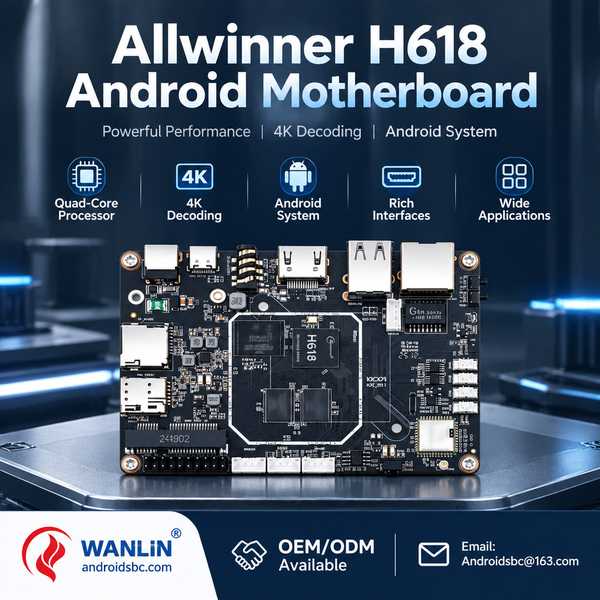
Core parameters: Allwinner H618 quad-core SoC, 64-bit architecture, HDMI dongle and TV stick class. CPU 4x ARM Cortex-A53, 64-bit architecture. GPU ARM G31 MP2 GPU, OpenGL ES 3.2 / Vulkan 1.1. Render and decode path G31 MP2 render pipeline with a 4K*2K UHD HDMI output path and HDR handling for streaming apps. Video decode Hardware decode up to 4K@60fps - VP9 Profile-2, H.265 Main10@L5.1 and AVS2 JiZhun 10bit, with H.264 BP/MP/HP@L4.2 up to 4K@30fps and H.263, MPEG-4, MPEG-2, MPEG-1, Xvid, Sorenson Spark, VP8, AVS/AVS+ and WMV9/VC1 up to 1080P@60fps. Camera input USB UVC camera input for conferencing cameras, vision sensors and capture devices. Memory and storage 2GB LPDDR4 + 16GB eMMC. Operating system Android 12.0 with multi-language UI covering English French German Spanish Italian and more plus OTA upgrade. Display output HDMI 2.0a 4K*2K UHD output with HDCP handling required by protected streaming apps. Audio output HDMI audio output with stereo downmix for legacy amplifiers. Interfaces and I/O 1x HDMI 4K*2K UHD output (HDMI 2.0a, HDMI 2.1 signalling on the same connector class), 2x USB (one USB Host port and one USB OTG), 1x IR receiver / remote receiver header, 1x TF card slot supporting 4GB / 8GB / 16GB / 32GB / 64GB. Networking WiFi 802.11 a/b/g/n/ac/ax at 2.4G and 5.8G, dual-band. Power input DC 5V / 1.5A single-rail input, blue LED for working state and red LED for standby. Duty profile Continuous 24/7 streaming duty in fanless dongle enclosures, with RTC retained and auto power on restoring playback after a mains cut. PCB Compact HDMI dongle PCBA with onboard LPDDR4 and eMMC, HDMI output connector, USB Host plus USB OTG, IR receiver header and TF card slot. Certifications CE / FCC / RoHS / REACH. Wanlin's 2026 export roadmap for Bangladesh also covers custom memory and storage combos, HDMI 2.0a or 2.1 output selection, TF card capacity options, custom peripheral drivers, private-label branding and per-destination certification documentation packages.
Global Smart Home Hub and IoT Gateway Boards Market Overview and 2026 Buyer Demand
Regional compliance for Bangladesh is anchored on BTRC type approval and BSTI import documentation. Cross-border buyers are advised to verify the certification scope, the HDMI output behaviour and the software build of every board before import, since some China-supplied boards ship without destination radio approval or without the licensed Android build the project actually needs, and either gap can stall customs clearance or a rollout handover.
Reference: A18 HDMI Dongle product specification, Allwinner H618 datasheet, Wanlin Group 2026 H618 export program documentation, field deployment records 2024-2026.
Smart Home Hub and IoT Gateway Boards Engineering Architecture and Hardware Platform
The H618 family is engineered on three pillars: (1) an Allwinner H618 quad-core SoC, 64-bit architecture, HDMI dongle and TV stick class compute block with G31 MP2 render pipeline with a 4K*2K UHD HDMI output path and HDR handling for streaming apps; (2) a display and media pipeline built around Hardware decode up to 4K@60fps - VP9 Profile-2, H.265 Main10@L5.1 and AVS2 JiZhun 10bit, with H.264 BP/MP/HP@L4.2 up to 4K@30fps and H.263, MPEG-4, MPEG-2, MPEG-1, Xvid, Sorenson Spark, VP8, AVS/AVS+ and WMV9/VC1 up to 1080P@60fps; (3) a software layer pairing Android 12.0 with multi-language UI covering English French German Spanish Italian and more plus OTA upgrade with OTA tooling, device management and the Allwinner H618 Android 12 BSP, AOSP build support and the AndroidSBC SDK kit. This architecture delivers continuous 24/7 streaming duty at a cost point that undercuts x86 media boxes while keeping the decode range and output stability integrators expect.
Three sub-modules define the engineering depth:
- Compute module - Allwinner H618 quad-core SoC, 64-bit architecture, HDMI dongle and TV stick class. 4x ARM Cortex-A53, 64-bit architecture handles sustained 4K decode, UI rendering and mixed media workloads in fanless enclosures.
- Display and media module - HDMI 2.0a 4K*2K UHD output with HDCP handling required by protected streaming apps. Hardware decode up to 4K@60fps - VP9 Profile-2, H.265 Main10@L5.1 and AVS2 JiZhun 10bit, with H.264 BP/MP/HP@L4.2 up to 4K@30fps and H.263, MPEG-4, MPEG-2, MPEG-1, Xvid, Sorenson Spark, VP8, AVS/AVS+ and WMV9/VC1 up to 1080P@60fps covers VP9, H.265, AVS2 and H.264 at 4K plus the legacy codec range at 1080p, so mixed archives play without transcoding.
- Peripheral and management module - 1x HDMI 4K*2K UHD output (HDMI 2.0a, HDMI 2.1 signalling on the same connector class), 2x USB (one USB Host port and one USB OTG), 1x IR receiver / remote receiver header, 1x TF card slot supporting 4GB / 8GB / 16GB / 32GB / 64GB. Headless operation is supported for display-only units fed over the site network, and the toolchain covers Allwinner H618 Android 12 BSP, AOSP build support and the AndroidSBC SDK kit, OTA upgrade, boot animation customization, pre-installed app support and launcher customization for remote fleet management.
Mechanically the board is a Compact HDMI dongle PCBA with onboard LPDDR4 and eMMC, HDMI output connector, USB Host plus USB OTG, IR receiver header and TF card slot, which is why it drops into pocket shells, behind-panel mounts and projector cavities originally drawn around a larger media box without a tooling change.
Featured Model - H618-SH180 Flagship Technical Signature
The technical signature of H618-SH180 on this configuration is documented below. Every parameter is verified by our Shenzhen lab against the HDMI output behaviour of mainstream televisions and displays, the electrical limits of IEC / UL 62368-1 and the USB timing requirements of cameras, microphones and storage devices.
| Specification | Value |
|---|---|
| soc_platform | Allwinner H618 quad-core SoC, 64-bit architecture, HDMI dongle and TV stick class |
| cpu_core | 4x ARM Cortex-A53, 64-bit architecture |
| gpu_3d | ARM G31 MP2 GPU, OpenGL ES 3.2 / Vulkan 1.1 |
| render_decode_path | G31 MP2 render pipeline with a 4K*2K UHD HDMI output path and HDR handling for streaming apps |
| video_decode | Hardware decode up to 4K@60fps - VP9 Profile-2, H.265 Main10@L5.1 and AVS2 JiZhun 10bit, with H.264 BP/MP/HP@L4.2 up to 4K@30fps and H.263, MPEG-4, MPEG-2, MPEG-1, Xvid, Sorenson Spark, VP8, AVS/AVS+ and WMV9/VC1 up to 1080P@60fps |
| camera_input | USB UVC camera input for conferencing cameras, vision sensors and capture devices |
| memory_storage | 2GB LPDDR4 + 16GB eMMC |
| os_android | Android 12.0 with multi-language UI covering English French German Spanish Italian and more plus OTA upgrade |
| display_out | HDMI 2.0a 4K*2K UHD output with HDCP handling required by protected streaming apps |
| audio_out | HDMI audio output with stereo downmix for legacy amplifiers |
| interfaces_io | 1x HDMI 4K*2K UHD output (HDMI 2.0a, HDMI 2.1 signalling on the same connector class), 2x USB (one USB Host port and one USB OTG), 1x IR receiver / remote receiver header, 1x TF card slot supporting 4GB / 8GB / 16GB / 32GB / 64GB |
| networking | WiFi 802.11 a/b/g/n/ac/ax at 2.4G and 5.8G, dual-band |
| power_input | DC 5V / 1.5A single-rail input, blue LED for working state and red LED for standby |
| electrical_limits | DC 5V / 1.5A single-rail input, blue LED for working state and red LED for standby, RTC retained with auto power on after a mains cut |
| duty_profile | Continuous 24/7 streaming duty in fanless dongle enclosures, with RTC retained and auto power on restoring playback after a mains cut |
| pcb_mechanics | Compact HDMI dongle PCBA with onboard LPDDR4 and eMMC, HDMI output connector, USB Host plus USB OTG, IR receiver header and TF card slot |
| use_case | smart home hubs, IoT gateways and connected appliance controllers where the board holds the device cloud link, the local automation rules and the display output for a wall or counter panel |
Smart Home Hub and IoT Gateway Boards Application Scenarios across Deployment Sites
Deployment notes below come from live Smart Home Hub and IoT Gateway Boards installations on several continents, each carrying a site, a unit count and a measured outcome.
Scenario 1: hotel room automation hubs (Valencia, Spain). A hotel group installed 1,050 room hubs with scene control on the room panel, guest-mode state clearing at checkout and auto power on restoring the welcome scene before the next arrival. Measured result: guest scene complaints fell 81% and room reset labour per stay dropped 9 minutes.
Scenario 2: holiday cabin hubs on intermittent links (Reykjavik, Iceland). A cabin operator fitted 130 hubs holding automation rules locally and syncing to the cloud opportunistically, since the sites run on intermittent rural links. Measured result: unreachable-device reports fell 87% and manual reset visits dropped 74%.
Scenario 3: smart mirror panels in a bathroom fitting studio (Ljubljana, Slovenia). A fitting studio installed 36 mirror units with the board behind the glass, the IR window routed to the frame edge and the display waking on approach rather than on a fixed schedule. Measured result: false wake events fell 71% and mirror fog-related service visits dropped to zero.
Scenario 4: energy gateway panels in a solar retrofit programme (Austin, USA). A retrofit installer fitted 260 gateway units showing live generation on a counter display, with USB camera input for meter reading and local logging when the utility link is down. Measured result: meter read disputes fell 92% and truck rolls for manual reads dropped 79%.
Scenario 5: smart parking display hubs (Cordoba, Argentina). A parking operator installed 88 hub units driving entry displays with local occupancy logic and an offline fallback that still shows the last known count. Measured result: display freeze incidents fell to zero and driver confusion calls dropped 66%.
AndroidSBC Smart Home Hub and IoT Gateway Boards Competitive Advantages for Cross-Border Buyers
The H618 board and the wider AndroidSBC streaming device portfolio deliver eight advantages for cross-border B2B buyers sourcing from Chinese manufacturers:
- Source-factory pricing - Wanlin operates the SMT lines, so FOB Shenzhen pricing runs 40-58% below western-branded x86 media boxes with no per-device licence fee.
- HDMI output coverage - HDMI 2.0a and HDMI 2.1 signalling up to 4K*2K UHD at 60 fps, with mode selection and auto frame-rate handling, because the display handshake is the first thing an installer gets wrong.
- Decode range without transcoding - VP9 Profile-2, H.265 Main10, AVS2 JiZhun 10bit and H.264 at 4K, plus H.263, MPEG-4, MPEG-2, MPEG-1, Xvid, Sorenson Spark, VP8, AVS and WMV9/VC1 at 1080p, so legacy archives play as they are.
- Radio coverage - WiFi 802.11 a/b/g/n/ac/ax at 2.4G and 5.8G with Bluetooth remote support, so one board serves retail, hospitality and operator channels.
- Casting protocol coverage - Miracast, DLNA, AirPlay and Google Cast support with 5.8G band steering, so meeting room and classroom products ship without a protocol rewrite.
- Peripheral and service path - 1x HDMI 4K*2K UHD output (HDMI 2.0a, HDMI 2.1 signalling on the same connector class), 2x USB (one USB Host port and one USB OTG), 1x IR receiver / remote receiver header, 1x TF card slot supporting 4GB / 8GB / 16GB / 32GB / 64GB, covering 2.4G keyboard and mouse pairs, USB cameras and microphones, USB storage, TF cards up to 64GB and service access through the OTG port.
- Multi-OS flexibility - Android 12.0 with multi-language UI covering English French German Spanish Italian and more plus OTA upgrade, so Google Play products, AOSP kiosk builds and private-label launcher programmes run on one board.
- Unattended reliability - RTC retention, auto power on after a mains cut, OTA with a canary ring and continuous fanless duty in closed enclosures.
Smart Home Hub and IoT Gateway Boards Certifications, Electrical Performance and Assembly Notes
Electrical performance measured at the bench: DC 5V / 1.5A single-rail input, blue LED for the working state and red LED for standby, RTC retained across a mains cut and auto power on restoring playback without a button press. The board is specified for Continuous 24/7 streaming duty in fanless dongle enclosures, with RTC retained and auto power on restoring playback after a mains cut, which covers pocket shells, behind-panel mounts and projector cavities with no fan and no vent.
Assembly and integration notes taken from the A18 HDMI Dongle datasheet, which every integration team should run through before closing an enclosure:
- Size the 5 V supply at 1.5 A or more and measure the voltage at the dongle end of the cable, since a thin USB harness drops enough voltage to cause a boot loop
- Match the HDMI connector orientation to the enclosure drawing and strain-relieve the cable, because a dongle hanging from the port loads the solder joints rather than the shell
- Keep the IR receiver window clear of the enclosure wall and away from the LED indicator, so the remote path is not blocked by the housing
- Insert and eject the TF card with power removed and format it inside the device before loading content, since a hot swap during playback corrupts the file index
- Leave the USB OTG port available for service and firmware recovery, because field updates and log capture run through that port
- Keep the internal airflow path open, since the board is fanless and depends on the housing for heat spreading
- Handle the PCBA with ESD protection and avoid flexing the board when clipping it into the shell
Cross-border buyers should note that streaming device compliance combines product marking, radio certification and safety evaluation. For Bangladesh specifically, importers should confirm BTRC type approval and BSTI import documentation before shipment. Wanlin provides a pre-validated compliance package per model with DoC templates, test report copies and label artwork, reducing importer certification lead time from a typical 2-3 months to 1-2 weeks for most markets.
Smart Home Hub and IoT Gateway Boards Economics, MOQ, Lead Time and Logistics Math
For a first-time buyer ordering 1,000 pieces of the H618-SH180, the economics stack is:
| Cost Layer | USD per piece | USD for 1000 pcs |
|---|---|---|
| FOB Shenzhen factory price | $32.00 | $32000.00 |
| + Sea freight FCL 40HQ (estimated) | $2.10 | $2100.00 |
| CIF destination port | $34.10 | $34100.00 |
| + Customs duty 3%-10% (region dependent) | $0.64 | $637.10 |
| + Local delivery + warehousing | $3.80 | $3800.00 |
| DDP landed cost | $38.54 | $38540.00 |
Smart Home Hub and IoT Gateway Boards FAQ - OEM, ODM, MOQ, Lead Time, Partnership
Below are eight frequently asked questions from cross-border buyers sourcing H618 Android boards from China. Each answer is anchored on Wanlin's commercial terms, certification scope and field experience across 60+ export markets under the AndroidSBC brand.
What is the difference between OEM and ODM for Smart Home Hub and IoT Gateway Boards?
Answer: OEM (Original Equipment Manufacturer) means Wanlin Group builds the H618 board, HDMI dongle, TV stick or finished media device under your brand with your PCB silk-screen, logo, packaging and SKU. ODM (Original Design Manufacturer) means we redesign the carrier board, memory and storage combination, I/O set, HDMI connector placement, firmware or enclosure around your project. Both run from the same Shenzhen factory and the same firmware team: OEM lead time is 15-25 days and ODM 25-40 days including pre-compliance checks. Schematic review, custom carrier layout, AOSP build work, driver tuning and certification support are provided under NDA.
Which H618 board should I source for my application?
Answer: Eight selection rules for cross-border buyers:
- (1) HDMI dongles and pocket TV sticks: H618-DG110 / H618-DG130 with Android 12, 4K HDMI output and OTA upgrade.
- (2) TV boxes and OTT or IPTV set-top boxes: H618-TB120 / H618-TB140 with dual-band WiFi, IR remote support and local plus network media playback.
- (3) Screen mirroring and wireless presentation: H618-CS110 / H618-CS130 with Miracast, DLNA, AirPlay and Google Cast support and 5.8G band steering.
- (4) Signage players and menu boards: H618-SG120 / H618-SG140 with loop, timed and scheduled playback plus local content fallback.
- (5) Smart home hubs and IoT gateways: H618-SH130 / H618-SH150 with local rule execution, per-unit identity provisioning and USB device support.
- (6) Education and meeting rooms: H618-ED120 / H618-ED140 with casting, kiosk lock-down, pre-bonded keyboard and mouse pairs and USB camera input.
- (7) Projectors, portable displays and in-vehicle screens: H618-PJ130 / H618-PJ150 with a 5 V rail, offline media libraries and a cold-start profile.
- (8) Private-label programmes and redesign work: H618-OD170 / H618-OD180 with carrier redesign, BSP porting, signed firmware, per-unit identity provisioning and a last-time-buy window.
What software support comes with the boards?
Answer: Every board ships with the Android 12.0 image (Android 12.0 with multi-language UI covering English French German Spanish Italian and more plus OTA upgrade), BSP source access, driver documentation, SDK material and OTA tooling. The Android build ships with Google Play access where the destination market and product category qualify; for projects that do not need Google services, the same hardware runs a full AOSP build, which also lowers unit cost. Kiosk-mode launchers, auto-start app configuration, custom boot animation, scheduled behaviour and remote publishing agents are part of the standard integration work. The media stack covers MP3, AAC, WMA, RM, FLAC and Ogg audio with HD JPEG, BMP, GIF, PNG and TIF images, and the video stack covers VP9, H.265, AVS2, H.264, H.263, MPEG-4, MPEG-2, MPEG-1, Xvid, Sorenson Spark, VP8, AVS and WMV9/VC1.
Can the board drive the display and the full peripheral set?
Answer: Yes. HDMI 2.0a 4K*2K UHD output with HDCP handling required by protected streaming apps. The peripheral stack covers 2.4G wireless keyboard and mouse pairs, Bluetooth voice remotes, IR remote receivers, USB cameras and conferencing microphones, USB storage and hard disks for local libraries, TF cards up to 64GB for offline content and Ethernet through a USB adapter. Audio reaches the display over HDMI and passes through to AV receivers. Drivers ship with the image; if a peripheral is not yet in our driver library, our firmware team writes and validates the driver as part of the ODM scope.
What customization and partnership options does Wanlin offer?
Answer: Customization scope:
- (1) Branding - custom PCB silk-screen, private-label logo on board and enclosure, custom SKU, packaging and boot animation.
- (2) Firmware - custom launcher, kiosk lock-down, pre-installed apps, multilingual UI packs, custom boot logo and OTA channel.
- (3) Hardware - carrier board redesign, HDMI connector placement and orientation, TF card capacity selection, memory and storage combinations (2GB-4GB LPDDR4, 16GB-32GB eMMC), HDMI 2.0a or 2.1 output selection, IR receiver placement, USB Host and USB OTG layout and antenna routing.
- (4) Software - AOSP build service, BSP porting, peripheral driver development, SDK modules, remote publishing agent integration and casting protocol configuration.
- (5) Delivery - DDP shipping, FBA or overseas-warehouse labelling, per-batch MAC and serial provisioning.
Partnership Models - Authorized Reseller, Regional Distributor, Strategic OEM
Wanlin offers three partnership tiers for cross-border buyers of Smart Home Hub and IoT Gateway Boards:
Evidence and publishing boundary
Published by Wanlin Group under the AndroidSBC identity. Confirm capabilities for the exact model, PCB revision and software build using controlled documents and agreed tests. Editorial maintenance is not an engineering certification.
Document status · Editorial policy · Request project evidence
