Wanlin Group · AndroidSBC · A133 smart charging locker board Standard
A133 smart charging locker board Standard
Review A133 smart charging locker board Standard requirements, interfaces, software and acceptance scope. Confirm the exact model configuration against current controlled project documents.
Configuration and document request
Content updated:
Use the exact configuration and controlled documents for a product decision.
Availability: Request confirmation for the selected configuration.
Details
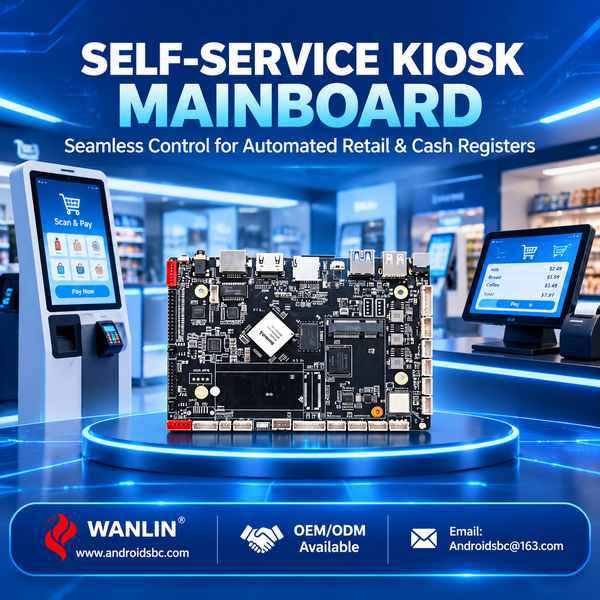
Core parameters: Allwinner A133 quad-core SoC, 22 nm process, cost-optimised retail platform. CPU 4x ARM Cortex-A53 @ 1.6 GHz, 64-bit. GPU Imagination PowerVR GE8300 GPU, OpenGL ES 3.2 / Vulkan 1.1. NPU CPU and GPU vision pipeline with an optional plug-in AI accelerator for face payment. Video decode Hardware 4K@30fps H.265 / H.264 decode, 1080p H.264 encode. ISP 5 MP ISP with MIPI-CSI camera input for scanner and camera modules. Memory and storage 2GB LPDDR4 + 64GB eMMC. Operating system Android 11 / Android 12, Linux (Debian / Ubuntu) and Tina Linux. Display output Single or dual display via LVDS + RGB + MIPI-DSI + HDMI 1.4, up to 1920 x 1080 per screen. Interfaces and I/O USB 2.0 x4 + USB OTG, RS232 x2 / RS485 x1, GPIO / I2C / SPI, optional CAN bus. Networking 10/100M Fast Ethernet with Gigabit option + WiFi 5 (802.11ac) + Bluetooth 5.0 + optional 4G LTE. Power input DC 12 V input, 9-36 V wide voltage optional. Operating temperature 0 to 60 deg C commercial, -20 to 70 deg C extended. Board dimensions Core board 85 x 56 mm / 3.5-inch SBC 145 x 100 mm / Pico-ITX 100 x 72 mm. Certifications CE / FCC / RoHS / REACH. Wanlin's 2026 export roadmap for Romania also covers custom memory and storage combos, single and dual screen configurations, custom peripheral drivers, private-label branding and per-destination certification documentation packages.
Global Smart Locker Control Android Boards Market Overview and 2026 Buyer Demand
Buyers shortlisting locker controllers rank lock-protocol coverage first: RS485, CAN bus and per-bay relay control decide whether a cabinet can be retrofitted, Standardising one controller across parcel, food and laundry cabinets cuts spare-part SKUs by 60% and simplifies field firmware work.
Regional compliance for Romania is anchored on CE under RED 2014/53/EU with Romanian documentation and RoHS declarations. Cross-border buyers are advised to verify the certification scope, the peripheral driver set and the software build of every board before import, since some China-supplied boards ship without destination radio approval or without the licensed Android build the project actually needs, and either gap can stall customs clearance or a payment audit.
Reference: Allwinner A133 datasheet, Allwinner A133 reference manual, Wanlin Group 2026 new retail hardware export program documentation, retail and hospitality deployment records 2024-2026.
Smart Locker Control Android Boards Engineering Architecture and Hardware Platform
The Smart Locker Control Android Boards family is engineered on three pillars: (1) a Allwinner A133 quad-core SoC, 22 nm process, cost-optimised retail platform compute block with CPU and GPU vision pipeline with an optional plug-in AI accelerator for face payment; (2) a display, camera and peripheral pipeline built around Hardware 4K@30fps H.265 / H.264 decode, 1080p H.264 encode; (3) a software layer pairing Android 11 / Android 12, Linux (Debian / Ubuntu) and Tina Linux with kiosk-mode management, OTA tooling and the Allwinner Tina Linux BSP and AOSP build support. This architecture delivers continuous retail duty at a cost point that undercuts x86 POS hardware while keeping the peripheral driver coverage and fleet tooling integrators expect.
Three sub-modules define the engineering depth:
- Compute module - Allwinner A133 quad-core SoC, 22 nm process, cost-optimised retail platform. 4x ARM Cortex-A53 @ 1.6 GHz, 64-bit handles sustained transaction, UI and on-device inference workloads in fanless kiosk enclosures.
- Display and camera module - Single or dual display via LVDS + RGB + MIPI-DSI + HDMI 1.4, up to 1920 x 1080 per screen. Hardware 4K@30fps H.265 / H.264 decode, 1080p H.264 encode drives single or dual screens, and the camera path serves scan, age-verification and face-payment modules.
- Peripheral and management module - USB 2.0 x4 + USB OTG, RS232 x2 / RS485 x1, GPIO / I2C / SPI, optional CAN bus. Headless operation is supported for lockers and vending, and the toolchain covers Allwinner Tina Linux BSP and AOSP build support, OTA upgrade, boot logo customization, pre-installed app support and launcher customization for remote fleet management.
Featured Model - WF-A133-LK120 Standard Technical Signature
The technical signature of WF-A133-LK120 on this configuration is documented below. Every parameter is verified by our Shenzhen lab against the panel specifications of mainstream LCD vendors, the electrical limits of IEC / UL 62368-1 and the serial timing requirements of common retail peripherals.
| Specification | Value |
|---|---|
| soc_platform | Allwinner A133 quad-core SoC, 22 nm process, cost-optimised retail platform |
| cpu_core | 4x ARM Cortex-A53 @ 1.6 GHz, 64-bit |
| gpu_3d | Imagination PowerVR GE8300 GPU, OpenGL ES 3.2 / Vulkan 1.1 |
| ai_vision | CPU and GPU vision pipeline with an optional plug-in AI accelerator for face payment |
| video_decode | Hardware 4K@30fps H.265 / H.264 decode, 1080p H.264 encode |
| camera_isp | 5 MP ISP with MIPI-CSI camera input for scanner and camera modules |
| memory_storage | 2GB LPDDR4 + 64GB eMMC |
| os_android | Android 11 / Android 12, Linux (Debian / Ubuntu) and Tina Linux |
| display_out | Single or dual display via LVDS + RGB + MIPI-DSI + HDMI 1.4, up to 1920 x 1080 per screen |
| retail_io | USB 2.0 x4 + USB OTG, RS232 x2 / RS485 x1, GPIO / I2C / SPI, optional CAN bus |
| networking | 10/100M Fast Ethernet with Gigabit option + WiFi 5 (802.11ac) + Bluetooth 5.0 + optional 4G LTE |
| power_input | DC 12 V input, 9-36 V wide voltage optional |
| operating_temp | 0 to 60 deg C commercial, -20 to 70 deg C extended |
| board_dimension | Core board 85 x 56 mm / 3.5-inch SBC 145 x 100 mm / Pico-ITX 100 x 72 mm |
| use_case | smart locker controllers for parcel, fresh food, medicine and battery cabinets |
Smart Locker Control Android Boards Application Scenarios across Deployment Sites
Field records from live Smart Locker Control Android Boards deployments follow. Sites, unit counts and outcomes come from rollout documentation across five continents.
Scenario 1: locker fleet on one managed firmware baseline (Prague, Czech). An operator moved 1,100 locker banks onto a single image with staged overnight OTA waves, per-bay health telemetry and automatic rollback after two failed boots. Measured result: firmware convergence reached 99.0% in eight days and truck rolls fell from 3.1 to 0.8 per site per quarter.
Scenario 2: locker bank in a transport interchange (Lima, Peru). A transit operator installed 22 locker banks with boards on a 4G link and a scheduled power profile, serving commuters with a QR code and an offline code cache when the link drops. Measured result: utilisation reached 71% of compartments per day and vandalism incidents fell 34% after camera logging was added.
Scenario 3: laundry and dry-cleaning lockers (Muscat, Oman). A laundry chain deployed 40 locker banks with boards driving a 10.1-inch panel, a receipt printer and per-door status LEDs, releasing garments after a staff scan at drop-off. Measured result: counter queue time fell from 9.5 to 2.8 minutes and staffed hours per site dropped 26%.
Scenario 4: fresh-food lockers with per-compartment cooling (Hamburg, Germany). A grocery click-and-collect service ran 96 outdoor lockers with boards sampling four temperature zones at 30 s intervals over RS485, holding 2 to 6 deg C and locking compartments that drift out of range. Measured result: temperature excursions fell from 14 to 1 per month and spoilage credits dropped 81%.
Scenario 5: tool lockers on a construction site (Auckland, New Zealand). A contractor placed 12 lockers with boards driving RFID badge release, a MIPI-CSI camera for handover photos and a battery-backed RTC so the audit trail survives mains loss. Measured result: missing-tool write-offs fell 78% and handover admin time dropped 12 minutes per shift.
AndroidSBC Smart Locker Control Android Boards Competitive Advantages for Cross-Border Buyers
The Smart Locker Control Android Boards and the wider AndroidSBC new retail portfolio deliver eight advantages for cross-border B2B buyers sourcing from Chinese manufacturers:
- Source-factory pricing - Wanlin operates the SMT lines, so FOB Shenzhen pricing runs 35-50% below western-branded x86 POS hardware with no per-device licence fee.
- Peripheral driver coverage - printers, scanners, scales, drawers, hoppers, note acceptors, RFID, NFC and card readers ship with tested drivers, because one unsupported device stalls a whole lane.
- Single and dual screen output - Single or dual display via LVDS + RGB + MIPI-DSI + HDMI 1.4, up to 1920 x 1080 per screen, including independent framebuffers so advertising or customer content never stalls the transaction process.
- Retail-grade I/O - USB 2.0 x4 + USB OTG, RS232 x2 / RS485 x1, GPIO / I2C / SPI, optional CAN bus, covering serial peripherals, mechanism control and wide-voltage power for unattended sites.
- Multi-OS flexibility - Android 11 / Android 12, Linux (Debian / Ubuntu) and Tina Linux, so app-driven retail projects and Linux-based locker or vending controllers run on one board.
- Custom memory and storage - 2GB-8GB LPDDR4 / LPDDR4X and 16GB-128GB eMMC, matching image size and workload to the deployment instead of paying for capacity the lane never uses.
- ODM depth - carrier board redesign, extra serial channels, custom connector maps, peripheral driver development, AOSP or Linux builds and private-label packaging from one factory.
- Continuous-duty reliability - hardware watchdog, RTC, scheduled power on and off, auto-reboot after power failure and 7x24 unattended operation for lockers, vending and off-grid sites.
Smart Locker Control Android Boards Certifications, Standards Route and Regional Compliance
Cross-border buyers should note that retail hardware compliance combines product marking, radio certification, safety evaluation and - for food-contact, weighing or payment functions - additional local evidence. For Romania specifically, importers should confirm CE under RED 2014/53/EU with Romanian documentation and RoHS declarations before shipment. Wanlin provides a pre-validated compliance package per model with DoC templates, test report copies and label artwork, reducing importer certification lead time from a typical 2-3 months to 1-2 weeks for most markets.
Smart Locker Control Android Boards Economics, MOQ, Lead Time and Logistics Math
For a first-time buyer ordering 1,000 pieces of the WF-A133-LK120, the economics stack is:
| Cost Layer | USD per piece | USD for 1000 pcs |
|---|---|---|
| FOB Shenzhen factory price | $118.00 | $118000.00 |
| + Sea freight FCL 40HQ (estimated) | $3.40 | $3400.00 |
| CIF destination port | $121.40 | $121400.00 |
| + Customs duty 3%-10% (region dependent) | $0.84 | $842.84 |
| + Local delivery + warehousing | $5.60 | $5600.00 |
| DDP landed cost | $127.84 | $127840.00 |
Smart Locker Control Android Boards FAQ - OEM, ODM, MOQ, Lead Time, Partnership
Below are eight frequently asked questions from cross-border buyers sourcing Smart Locker Control Android Boards from China. Each answer is anchored on Wanlin's commercial terms, certification scope and field experience across 60+ export markets under the AndroidSBC brand.
What is the difference between OEM and ODM for Smart Locker Control Android Boards?
Answer: OEM (Original Equipment Manufacturer) means Wanlin Group builds the retail terminal board, smart kiosk controller or finished new retail terminal under your brand with your PCB silk-screen, logo, packaging and SKU. ODM (Original Design Manufacturer) means we redesign the carrier board, memory and storage combination, I/O set, peripheral drivers, firmware or enclosure around your project. Both run from the same Shenzhen factory and the same firmware team: OEM lead time is 15-25 days and ODM 30-45 days including pre-compliance checks. Schematic review, custom carrier layout, AOSP or Linux build work, peripheral driver development and certification support are provided under NDA.
Which new retail board should I source for my application?
Answer: Eight selection rules for cross-border buyers:
- (1) All-in-one new retail smart terminals and service desks: WF-A133-NR120 / NR140 with a 21.5-inch main panel, a 10.1-inch customer screen, scanner on USB and label printer on RS232.
- (2) Smart vending machines and unattended coolers: WF-A133-VM140 / VM160 with MDB or RS485 mechanism control, per-slot relay output and 4G telemetry.
- (3) Parcel, fresh-food, medicine and battery-swap lockers: WF-A133-LK130 / LK140 with 16-24 lock channels over RS485, CAN bus pack monitoring and per-bay telemetry.
- (4) Digital signage, menu boards and in-store media networks: WF-A133-SG110 / SG120 with scheduled daypart content, proof-of-play reporting and per-screen brightness control.
- (5) Self-service checkout lanes and unattended payment kiosks: WF-A133-SC120 / SC150 with a 2D scanner, bagging-verification scale, cash-recycling unit and an offline authorisation queue.
- (6) Unmanned stores and micro-markets: WF-A133-UM150 / UM170 with MIPI-CSI grab-and-go vision, door release control and remote OTA over 4G.
- (7) Dual-screen and triple-display interactive counters: WF-A133-MD150 / MD170 with independent framebuffers, per-screen rotation and independent brightness control.
- (8) Private-label and fully custom programmes: WF-A133-OD170 / OD180 with custom carrier board, custom firmware and branded packaging.
Can the board drive two screens and the full retail peripheral set?
Answer: Yes. Single or dual display via LVDS + RGB + MIPI-DSI + HDMI 1.4, up to 1920 x 1080 per screen. The peripheral stack covers thermal printers and fiscal printers on RS232, barcode scanners on USB or serial, cash drawers on relay outputs, weighing scales on RS232, coin hoppers and note acceptors on serial, RFID readers on USB, card readers and NFC on USB, fingerprint and face-payment modules on USB or MIPI-CSI, and mechanism control on RS485, MDB or CAN bus. Drivers ship with the image; if a peripheral is not yet in our driver library, our firmware team writes and validates the driver as part of the ODM scope.
What customization and partnership options does Wanlin offer?
Answer: Customization scope:
- (1) Branding - custom PCB silk-screen, private-label logo on board and enclosure, custom SKU, packaging and boot animation.
- (2) Firmware - custom launcher, kiosk lock-down, pre-installed apps, fiscal receipt templates, custom boot logo and OTA channel.
- (3) Hardware - carrier board redesign, extra serial channels, custom connector maps, memory and storage combinations (2GB-8GB LPDDR4 / LPDDR4X, 16GB-128GB eMMC), single or dual screen output, 4G / 5G module options and CAN bus expansion.
- (4) Software - AOSP build service, Linux BSP porting, peripheral driver development, SDK modules, OTA server setup and on-device model conversion for face payment and item recognition.
- (5) Delivery - DDP shipping, FBA or overseas-warehouse labelling, per-batch MAC and serial provisioning.
Partnership Models - Authorized Reseller, Regional Distributor, Strategic OEM
Wanlin offers three partnership tiers for cross-border buyers of Smart Locker Control Android Boards:
Evidence and publishing boundary
Published by Wanlin Group under the AndroidSBC identity. Confirm capabilities for the exact model, PCB revision and software build using controlled documents and agreed tests. Editorial maintenance is not an engineering certification.
Document status · Editorial policy · Request project evidence
